
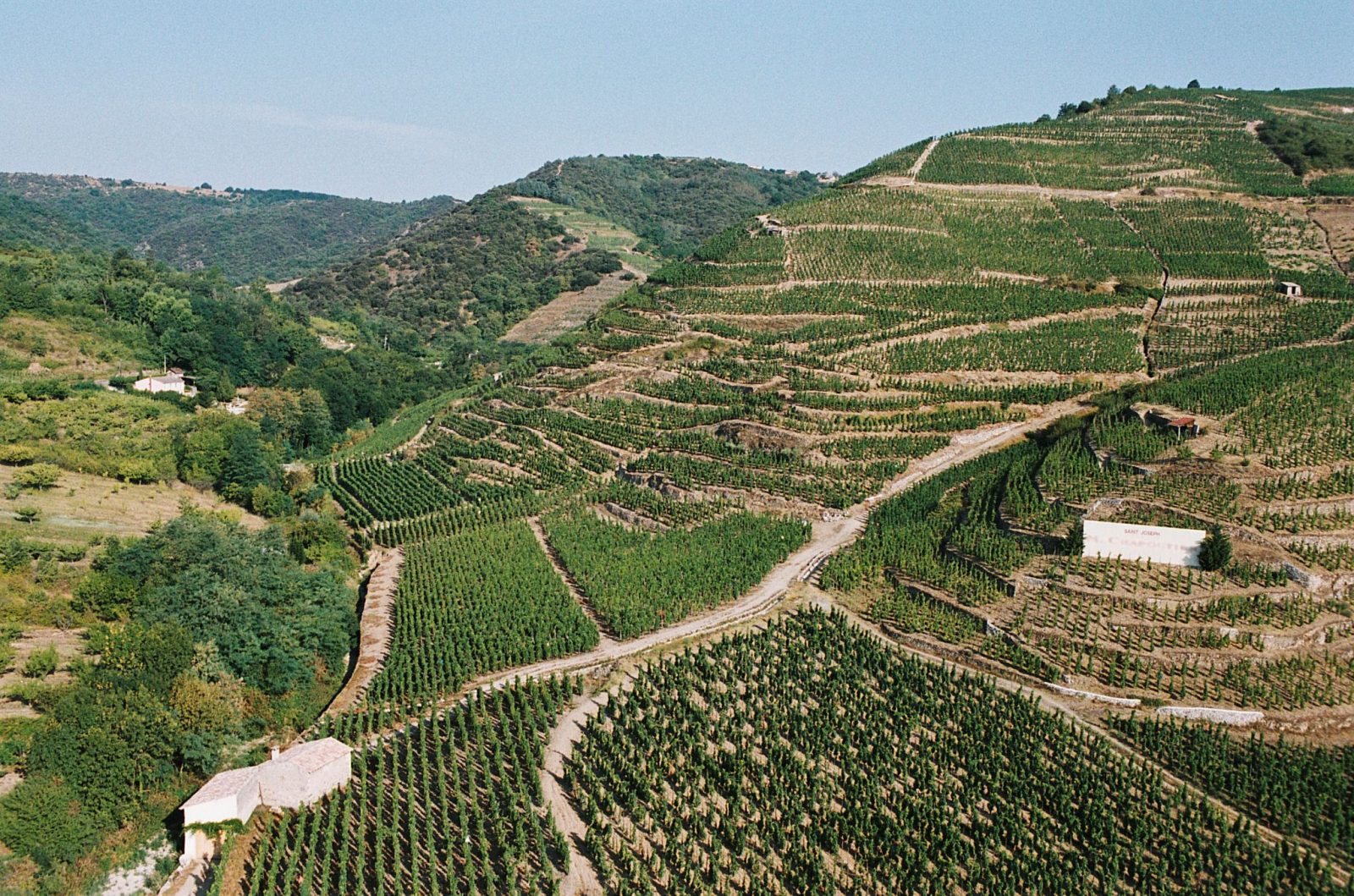
About Marsanne & Roussanne from the Northern Rhône
Marsanne’s origin is believed to be in the Rhône valley but not proven as of yet. Its close relative, Roussanne, shares the same question mark about its origin but both varieties strive and prosper predominately in the Northern Rhône valley. Total plantings in France (as per 2019 statistics) are 2289 hectares for Roussanne and Marsanne with 1798 hectares. (Harding et al., 2023)
Having said that Marsanne is significantly wider planted in the Northern Rhône than Roussanne.
Where they differentiate is their natural acidity level, being higher in Roussanne and their resistance level to powdery mildew and rot, where Marsanne generally fares better.
It’s rather common to blend them as Marsanne brings body, intensity and structure and Roussanne provides the perfume, elegance and often the needed acidity.
In this article, we are going to focus on the aroma and flavour profile of Marsanne & Roussanne from Northern Rhône, following a structure commonly used by wine institutions like Court of Master Sommeliers (COMS) and Wine & Spirit Education Trust (WSET). We will also compare it with other grape varieties and call out what makes Marsanne and Roussanne blends unique.

Appearance

Colour – Pale to medium straw

Hue – Golden/ cooper (Higher percentage of Roussanne accentuates the golden/cooper reflection)

Brightness – Bright (Higher percentage of Roussanne often intensifies the brightness)

Viscosity – Medium +

Aromas and flavours
Summary – Highly aromatic and heady floral intensity
Citrus
Lemon (fresh, zesty or tart), lemon (ripe to overripe, candied zest or peel), orange & candied orange peel
Orchard
Yellow/golden apple, pear (underripe, tart), quince (just ripe)

Stone
Mirabelle plum (Yellow plum)
Exotic
Honeydew melon
Floral
Dried white flower, white flower, honeysuckle, linden flower

Honey
Honey, candle wax, lanolin

Blossom
Apple blossom
Herbal
Dried herbal note

Spice
Vanilla, white pepper (grounded)
Tea
Almond, white tea

Inorganic
Limestone/chalk/flint, granite, salty mineral
Oak
Present (but generally well integrated)

Sweetness
Dry

Acidity
Medium

Alcohol
Medium plus – high 13% -14.5% and higher

Body
Medium to full bodied

Comparison to others
Chardonnay (outside of Europe)
- Can show similar intensity for the non-fruit elements like the florality, spices and nuts. Often more exotic fruit scented with mango, pineapple and generally a riper style.
Pinot Gris from Alsace
- Similar colour with cooper/golden variations. Often Pinot Gris is more aromatic and fruity in style with a more oily texture and weight with no obvious use of oak. Furthermore Pinot Gris is more likely to show some residual sugar in the finished wine.


What makes it unique
- Full bodied, heady & heavenly scented with an abundance of floral notes (dried and fresh).
- Textured with layers of honey, almonds and a pleasant phenolic bitterness. Often pear and quince are picked up as main fruits with an persistence mineral mid palate.

Legal requirements
- Only 4 regions are allowed to produce Marsanne and Roussanne blends in the Northern Rhone, and they are St. Joseph, Crozes Hermitage, Hermitage and St. Peray.
- The total surface of St. Joseph is approximately 1,300 hectares, only 10% is designated to white wine production.
- Majority of wines are based on Marsanne at 80%, with Roussanne as a blend at no more than 20%.

Stefan Neumann MS
Austrian born, London based Master Sommelier – I am passionate about wine and a strong believer that wine should connect people. Hence I have made it my mission to share my wine knowledge and experience with like-minded individuals who would like to be part of this journey.
References:
Harding, J., Robinson, J. and Thomas, T.Q. (2023) The Oxford Companion to Wine. Oxford: Oxford University Press.
- How to identify Amarone della Valpolicella from Veneto in a blind wine tasting?
- How to identify Sauvignon Blanc from Loire Valley in a blind wine tasting?
- How to identify Marsanne & Roussanne from the Northern Rhône in a blind wine tasting?
- How to identify Viognier from Northern Rhône in a blind wine tasting?
- How to identify Riesling from Alsace in a blind wine tasting?