
About the course
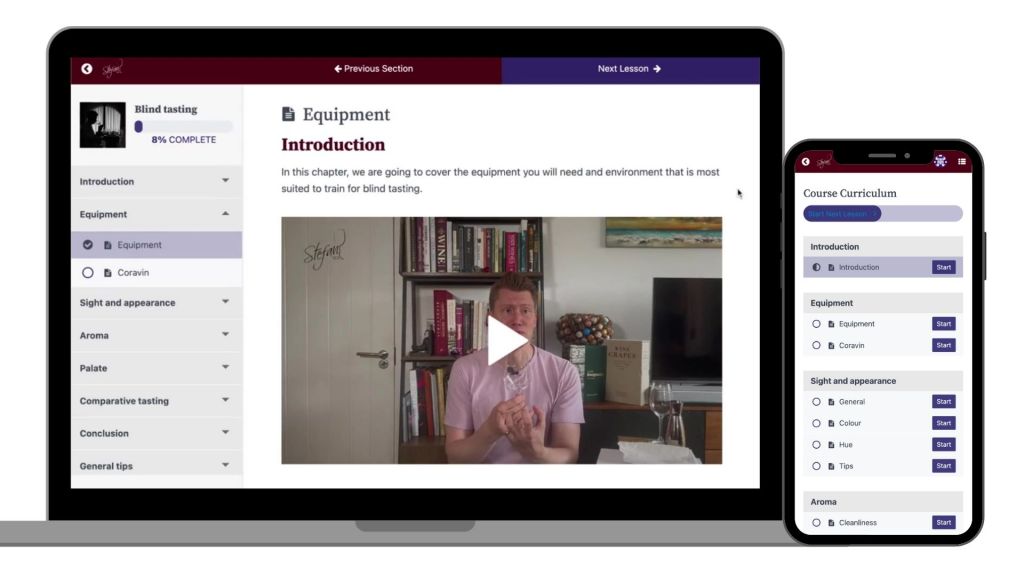
- Online video course about wine blind tasting hosted by Master Sommelier Stefan Neumann
- Find out Stefan’s secret to success that helped him to become a Master Sommelier
- 9 modules, 3 hours, over 50 bite-sized videos
- Learn how to correctly identify grape variety, region and vintage
- Increase your chance of passing a blind tasting exam or simply get better
as Seen on Decanter and Harpers Wine & Spirit


Who is the course for?
Predominantly for candidates who are sitting for wine exams that involve blind wine tasting across different levels, from beginner to expert
Why sign up?
Learn from a Master Sommelier and find out the secret to success in blind tasting
Study anywhere, anytime – unlimited access to 9 modules, 3 hours, over bite-sized 50 videos
Learn what you need to do to identify the wine from grape varieties, vintage to region, soil and so on
Only £12/month for 12 months or £15/month for 6 months (based on annual/bi-annual subscription)

Stefan Neumann MS
Stefan became a Master Sommelier in 2017 and has been tasting regularly for various wine competitions and wine awards over the last decade including Decanter World Wine Award, IWSC and 50 Great Greek Wines to name a few. In 2022, he became the Regional Chairman for Switzerland at Decanter World Wine Award.
Learning outcomes
- Set up a solid foundation of your blind tasting structure, from equipment, aromas, palate to wine making techniques, soil and climate influence
- Learn how to understand your own senses, how to train and sharpen them
- How to find the reference point for your own palate and build up a taste profile
- Expand your vocabularies, descriptors and improve your structure when analysing the wine
- How to get into the right mindset, channel your emotions throughout the often very long process, so you can perform and deliver on the day
Course syllabus
Introduction
What is blind tasting? Why is it important in the world of wine? How to make the most out of this course. (1 video)
It also defines what are considered as classic grape varieties for the purpose of exams.

Equipment and environment (Including a sneak peak to one of the episodes)
This lesson covers the equipment you will need and environment you should train in. (3 videos)
Sight and appearance (Including a sneak peak to one of the episodes)
This lesson covers things to look out for when analysing the sight and appearance of a wine, from colour, hue and beyond. (4 videos)
Aroma
In this lesson, you will find a detailed breakdown of all the most common aromas that you should consider and be familiar with when tasting wine professionally. (13 videos)
Palate
In this lesson, it provides an extensive flavour profile, structure and Stefan’s recommended approach on how to analyse a wine on the palette – both white and red. (16 videos)
Comparative tasting
What is comparative tasting and why is it important? It also includes a library of comparison videos where Stefan compares 2-3 similar wines side by side, that are similar or easily confused, that will help you find your own identifiers. (9 videos and growing)
Conclusion
What is a pre conclusion and final conclusion? What to include and look out for? (2 videos)
General tips
Other things you can do during training, pre exam and during exams to help you taste better. 3 videos
What our members from the community are saying
Joanna Nerantzi – Assistant Head Sommelier at Estelle Manor
During the year in which I was preparing for the Advanced Certification of the Court of Master Sommeliers and wine competitions, I enrolled in Stefan’s Course. I was thoroughly impressed, not only by the comprehensive and impeccably organized content, but also by the continuous depth of knowledge I gained with each revisit. I believe it serves as an outstanding resource for blind tasting exercises, benefiting both wine students and enthusiasts alike. I extend my heartfelt gratitude to Stefan for this exceptional learning experience!
Sanya Abhay – Wine Educator and Judge
Stefan has been extremely generous with his time, providing invaluable guidance and support through my Master Sommelier journey. He nurtures a positive learning environment thanks to his deep technical knowledge and warm, uplifting personality. Stefan is a consummate professional and a glowing example for sommeliers.
Maria Boumpa – Head Sommelier and Wine Buyer at Da Terra
I met Stefan just before sitting my CMS Certified Exam a few years ago, seeking some guidance with blind tasting. His assistance both in blind tasting and theory was invaluable and helped me achieve the highest score in my class. Currently, pursuing the CMS Advanced in April 2024, I have been attending Stefan’s in-person tasting sessions and signed up for his Online Tasting Courses. His engaging, fun and most of all educational way made me a better taster and gave me a better understanding of blind tasting. Stefan is an inspiration and I will continue to seek advice and mentorship on my journey to the MS Exam in the future!
Daniel Stojcic – Deputy Head Sommelier at Estelle Manor
Having had a chance to learn from Stefan just before my Advanced exam last autumn was of invaluable meaning. He challenged my thinking when it comes to blind tasting, and in return made me a better taster.
Learning from Stefan’s thought process of how to approach a blind tasting certainly increased my chances of passing and I’m very grateful to have him as an inspiration to draw from and I will seek his mentorship and advice in future on my journey to the MS exam. Thank you for your guidance, Stefan!
Frequently Asked Questions
Is this associated or accredited with any exam organisations?
No – the course is designed purely to help individuals to improve their blind tasting skill based on Stefan’s personal experiences through studying and passing the various stages of the Court of Master Sommelier exams, as well as his career as a sommelier throughout the years.
What level of wine knowledge do I need to sign up?
The course aims at individuals who are interested in wine and have a basic understanding or already working/studying about wine. It covers all levels from basic (e.g. WSET level 1 or 2 / Introductory Sommelier from Court of Master Sommelier) to expert (up to Advanced Sommelier or WSET Diploma candidates).
It is also a good refresher course for those who are returning to blind tasting from a break (e.g. you passed your Advanced Sommelier a couple of years ago and now preparing for Master Sommelier exam).
The idea of this course is like a book. You can come back to these lessons time and time again. As your knowledge and experience develop, you will find certain areas/lessons more relevant and useful than before.
I am preparing for an exam hosted by the Court of Master Sommelier (COMS), will this course also be covered by courses offered by the COMS?
No – this course is not related, sponsored or associated by the Court of Master Sommelier or any other wine education bodies. It is for your personal development in addition to any qualifications you are preparing for.
I am preparing for my WSET diploma, is this course relevant for me?
Whilst the Court of Master Sommelier (COMS) and Wine and Spirit Education Trust (WSET) have different approaches and requirements in their syllabus and exams, the course focuses on developing your own blind tasting ability and giving you frameworks and techniques that will help you to improve your own senses, reference points, approaches and broaden your understanding of the relation between climate, wine making techniques, soil conditions etc and your own palate. These are skills that will help you become better at blind tasting, irrespective the organisation you are sitting the exam with.
I am studying for my WSET Diploma. The course is based on the experience of a Master Sommelier who has a different approach and qualified on a different basis than WSET. How is this relevant for me?
Certainly the WSET programme is different to Court of Master Sommelier in many aspects, and the blind tasting exam is no exception. Both exams present different set of challenges, they require candidates to follow a different structure when analysing wines, and fundamentally both require candidates to accurately and thoroughly identify the grape variety, origin, vintage, climate, wine making techniques, quality assessment and the list goes on. Therefore, this course will also help WSET students with exactly just that.
How much is the course?
There are 2 options – £15/month based on a 6 month subscription, or £12/month based on a 12 month subscription.
Are the videos live?
Videos are not live so you can watch them whenever, where-ever it suits you, and as many times as you want.
How can I sign up?
Simply click on the sign up link here
Can I share the account with others?
Every individual requires an account and cannot be shared with others. An account will be terminated immediately if there is evidence of log-in sharing, more details can be found on our terms and conditions.
I have a team of sommeliers/front of house staff who would like to sign up, do you offer a group subscription?
Please contact us directly and we can discuss your requirements and provide a bespoke subscription accordingly. Email us: customerservice@stefanneumann.co.uk
Is the course refundable?
The course is non-refundable, non-transferable and non-redeemable. If you have any questions prior to signing up, please feel free to reach out on customerservice@stefanneumann.co.uk and we’ll do our best to help.
Will I receive a certificate upon completion?
We would love to say yes, it is not something we offer at this stage.
How long do I have access for?
The course is offered on a bi-annual or annual basis, from the day you sign up.
Can I subscribe for less than 6 months?
6 months is the minimum requirement for the course. You will get unlimited access to all lessons in your own time. If you are unsure and want to have a sneak peak of the course, we suggest you take a look at the videos under Course syllabus – Equipment and environment and Sight and appearance to get an idea what to expect.
Do you offer a free trial?
Free trial is not available at this stage. If you are unsure and want to have a sneak peak of the course, we suggest you take a look at the videos under Course syllabus – Equipment and environment and Sight and appearance to get an idea what to expect.
What language is the course in?
The primary language of the course is in English, and vocabularies in foreign languages will be used throughout to describe regions, grape varieties and etc.
Do you offer personal feedback on my blind tasting?
We offer bespoke training on request. Please feel free get in touch to find out more on customerservice@stefanneumann.co.uk
Why are there only classic grape varieties covered in this course?
This course focuses on the so called classic grape varieties which are worldwide distributed, widely available and provide fair reference points to everyone who is preparing for an exam or simply enjoys blind tasting. Furthermore, classic grape varieties and wines have a common thread and characteristic which makes them recognisable and identifiable for a broader audience.
Why are there no orange / low intervention or wines from lesser known wine countries being referenced in this course?
It is about equity and equality by promoting fairness and justice yet being able to give the same access to everyone. Not everyone will have access to Assyrtiko from Santorini or Mtsvane from Georgia. As good as these wines are there is firstly not yet enough of a common and agreeable style found and secondly the available production volume is too low to grant fair access to everyone.
Will I receive any bottles of wine for this course?
Not currently but we are considering making this a feature premium subscription.
Disclaimer
Blind tasting is incredibly personal and subjective. There is no absolute right or wrong way of defining flavours and aromas, and use this course as guidelines to help you build your own reference point and flavour profiles for classic varieties.
The course is based on Stefan’s personal experience and blind tasting journey. This is not suggesting any experiences or journeys are better than others and there is only one way to learn and improve.