
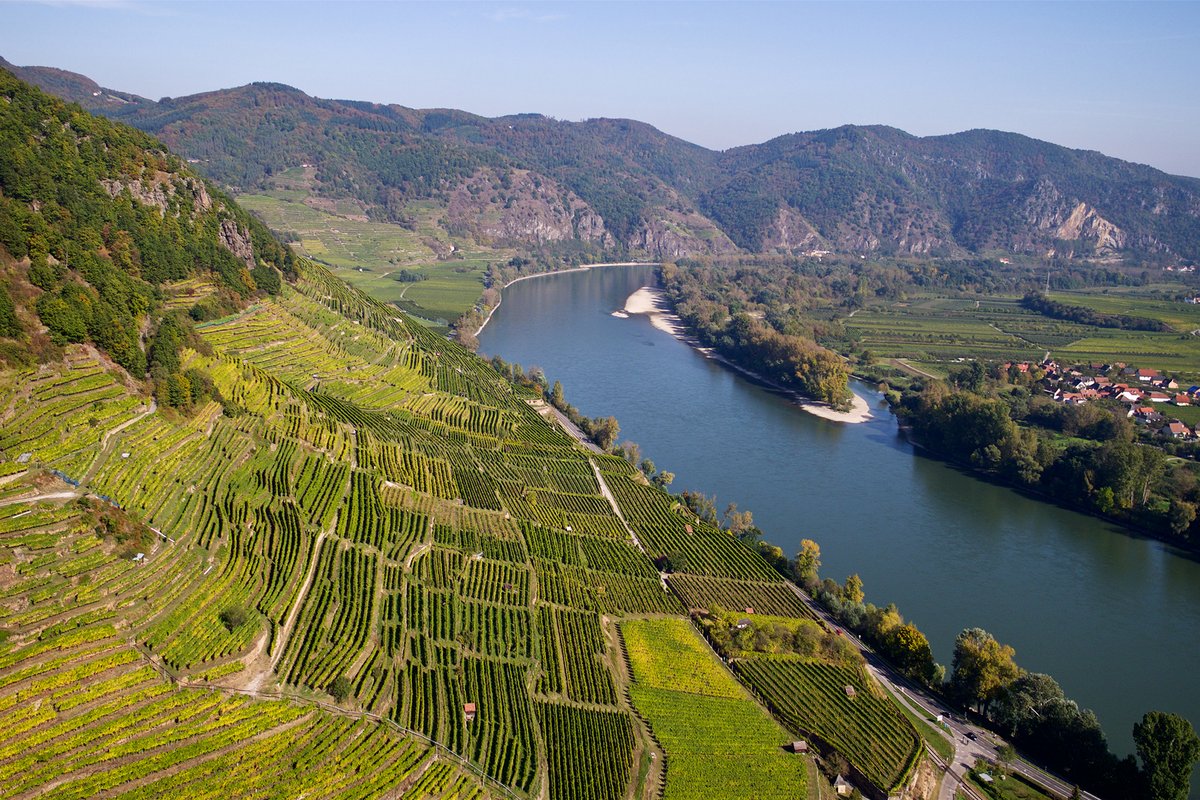
Grüner Veltliner is native to Austria with 14,612 hectares (Harding et al., 2023) and is the most planted white variety taking almost ½ of the country’s white vineyard area.
A spontaneous cross of Savagnin (Traminer) and St. Georgener from Eisenstadt. It is not genetically related to Roter Veltliner or Frühroter Veltliner. (Robinson et al., 2012)
Commonly used names and synonyms are: Grauer Veltliner or Weissgipfler (Austria), Veltlin or Veltlínské Zelené (Czech Republic), Zöldveltelini (Hungary), Zeleni Veltinec (Slovenia), Veltliner (Alto Adige) – (Robinson et al., 2012)
In this article, we are going to focus on the aroma and flavour profile of Grüner Veltliner, following a structure commonly used by wine institutions like Court of Master Sommeliers (COMS) and Wine & Spirit Education Trust (WSET). We will also compare it with other grape varieties and call out what makes Grüner Veltliner unique.
.

Appearance
Light to medium intense pale straw core, very often with green hue/ reflections “Grüner” in German means Green.

Aromas and flavours
Fruits:
- (Lighter styles (e.g. Steinfeder) – Citrusy (fresh lemon/lime), green apple, under-ripe pear, white peach, yellow plum
- Ripper styles (e.g. Smaragd) – Yuzu, candied orange peel, yellow apple, ripe peach
Floral: white slight dried floral
Vegetal: white asparagus, radish, green peas, cabbage
Herbal: Pea shoots, fresh parsley
Others: white grounded pepper, often very mineral focused wines

Sweetness
Dry (watch out for botrytis that can give a “false” sweetness – e.g. Smaragd)

Acidity
Medium plus to high

Alcohol
Lighter style from 11.5% ABV to riper style reaching 14%

Body
Majority is refreshing and crisp
Smaragd – rich, rounded & full bodied

Comparison to others
Lighter styles of Grüner Veltliner can be easily confused with Albariño but it has little to no vegetal note and generally lower acidity in comparison to Grüner Veltliner. Riper styles of Grüner Veltliner (Smaragd) are commonly confused with riper styles of Viognier (Condrieu). Acidity is the key here. Grüner will generally have higher more perceivable acid levels and a more vegetal aroma profile.

Classic examples
- Domäne Wachau in Wachau
- Stadt Krems in Kremstal
- Weingut Schloss Gobelsburg in Kamptal

What makes it unique
The combination of
- (at least) medium plus acidity
- Refreshing vegetal note
- Strong mineral note
- Signature white pepper note

Stefan Neumann MS
Austrian born, London based Master Sommelier – I am passionate about wine and a strong believer that wine should connect people. Hence I have made it my mission to share my wine knowledge and experience with like-minded individuals who would like to be part of this journey.
References:
Jancis Robinson, Harding, J. and Vouillamoz, J. (2012). Wine grapes : a complete guide to 1,368 vine varieties, including their origins, flavours and wines. London: Penguin.
Harding, J., Robinson, J. and Thomas, T.Q. (2023) The Oxford Companion to Wine. Oxford: Oxford University Press.
- How to identify Amarone della Valpolicella from Veneto in a blind wine tasting?
- How to identify Sauvignon Blanc from Loire Valley in a blind wine tasting?
- How to identify Marsanne & Roussanne from the Northern Rhône in a blind wine tasting?
- How to identify Viognier from Northern Rhône in a blind wine tasting?
- How to identify Riesling from Alsace in a blind wine tasting?