
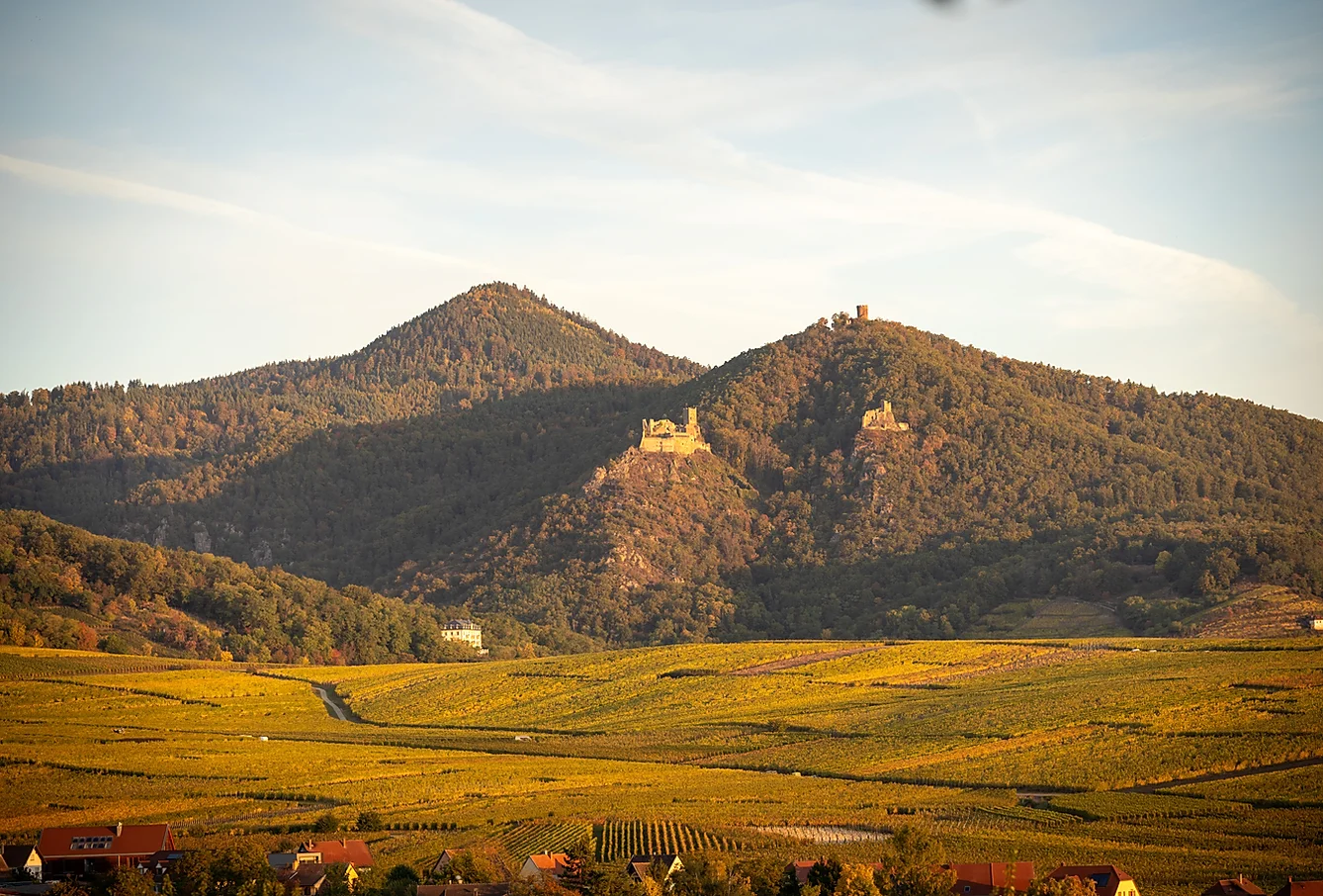
About Gewurztraminer from Alsace
Gewurztraminer is the aromatic mutation of Savagnin Rose and maybe the best known with the Savagnin family tree.
First mentioned in the village of Oppenheim, which is now within the Rheingau region in Germany. A variety that is particularly prone to virus diseases, hence there are 8 specifically bred virus-free version in the Alsace.
Nowadays, the Alsace is commonly considered as its home turf and with around 3,000 hectares, a widely planted grape variety. Having said that, you will also find it in Germany, Italy, Spain, Hungary and in the States, especially in California, Oregon and Washington.
In this article, we are going to focus on the aroma and flavour profile of Gewurztraminner, following a structure commonly used by wine institutions like Court of Master Sommeliers (COMS) and Wine & Spirit Education Trust (WSET). We will also compare it with other grape varieties and call out what makes Gewurztraminner unique.

Appearance

Colour – Medium to deep straw (Often the deepest white wine in the line up)

Hue – Rose/ golden

Brightness – Bright but rarely brilliant

Viscosity – Medium + to high viscosity

Aromas and flavours
Summary: Highly aromatic and pronounced, with a ripe to over-ripe fruit intensity.
Citrus
Lemon, orange, mandarin, yuzu (ripe to overripe, candied zest or peel)
Orchard
Yellow/golden/red apple, quince (ripe to overripe)

Stone
Peach, nectarine, apricot (ripe)
Exotic
Pineapple, mango, lychee, kiwi, honeydew melon, guava
Floral
White flower, as well as geranium and rose, orange/apple blossom

Spice
All spice, cardamon, cinnamon

Organic
Granite, musky (woody & earthy with floral & fruity undertone)

Others
Honey, Turkish delight, orgeat (almonds, sugar, rose/orange water)

Sweetness
Dry to off-dry

Acidity
Medium

Alcohol
Medium plus – high 13% -14.5% and higher

Body
Medium to full bodied. Use of oak but barely detectable

Comparison to others
Pinot Gris from Alsace
- Tends to be less exotic fruit driven with a more orchid fruit spectrum (apples and pears)
- Has a slightly higher acidity level and a less golden appearance with a grey/silver hue
- Less floral and evident than Gewurztraminer and the focus is more on elderflower than rose


What makes it unique
- Its fruitiness! The nickname of Gewurztraminner (GWZT) is “fruit salad” as it boosts a wide array of different fruits – pretty much covering all groups
- Lychee is often its most distinctive fruit
- Its appearance and high viscosity level plus the elevated alcohol paired with the notes or rosewater, honey and Turkish delights

Did you know?
- Alsace labels their Gewurztraminer without the “u” umlaut
- German-speaking countries label it with the umlaut = Gewürztraminer

Stefan Neumann MS
Austrian born, London based Master Sommelier – I am passionate about wine and a strong believer that wine should connect people. Hence I have made it my mission to share my wine knowledge and experience with like-minded individuals who would like to be part of this journey.
References:
Jancis Robinson, Harding, J. and Vouillamoz, J. (2012). Wine grapes : a complete guide to 1,368 vine varieties, including their origins, flavours and wines. London: Penguin.
Harding, J., Robinson, J. and Thomas, T.Q. (2023) The Oxford Companion to Wine. Oxford: Oxford University Press.
- How to identify Amarone della Valpolicella from Veneto in a blind wine tasting?
- How to identify Sauvignon Blanc from Loire Valley in a blind wine tasting?
- How to identify Marsanne & Roussanne from the Northern Rhône in a blind wine tasting?
- How to identify Viognier from Northern Rhône in a blind wine tasting?
- How to identify Riesling from Alsace in a blind wine tasting?